In our previous article we explained how to make the most of our GranEssere ingredients to bake wholemeal panettone and fibre-rich panettone.
These ingredients, added at the last minute as a suspension, result in a fibre-rich artisanal panettone made exclusively from soft wheat grain, that can be enjoyed at any time of the year. A highly leavened cake, which professionals can be proud of that satisfies the fussiest of foodies with its new and unique flavour.
In this article we supply you with a practical guide to the creation of a wheat germ panettone, an innovative leavened cake characterised by its one of a kind flavour, aroma and look… not to mention the incredible nutritional properties of the wheat-germ!
The fundamental ingredients for baking wheat germ panettone
Before going into the procedure of the recipe for wheat germ panettone, let’s take a look at the necessary ingredients, especially the GranEssere fibres.
The special GranEssere range offers products obtained by the StabilEasy® – Natural Steam Stabilization method, which makes Mulino Padano unique on the Italian industrial milling scene.
This process took three years of research and experimentation to develop. After cleaning, the grain undergoes steaming at a strictly controlled temperature and humidity. StabilEasy® is a totally natural method which, thanks to the use of steam, deactivates the enzymatic activity responsible for the oxidation of the lipid component of the grain. This process results in flours and advanced ingredients such as bran and wheat germ, which are fibre-rich and healthier, because the bacterial content of the external caryopsis of the grain is lessened, and the organoleptic characteristics are heightened. GranEssere products are generally sweeter and tastier and have a more intense aroma. And not only, as tests prove, the StabilEasy® method, in a totally natural way, lengthens the shelf life of products such as bran and wheat germ which are otherwise renowned for having a very brief shelf life.

Course bran, fine bran and wheat germ from the special GranEssere range are the perfect ingredients for baking artisanal wholemeal panettone and fibre-rich panettone. They can be used in any traditional recipe without modification whilst ensuring perfect workability and excellent leavening. Neither the first or second mixture changes.
For the first mixture Mulino Padano suggests using Type “00” Panettone flour, made from high protein content grains, which give the dough strength and stability. It is in the second mixture the other ingredients of the special GranEssere range come into play. Coarse or fine bran or wheat germ are added to the final phase of elaboration as a suspension.
It is important to remember, before going on, that the following recipe is an example! Don’t forget that GranEssere fibres can be adapted to your own recipe, so if you have a tried and tested recipe for traditional panettone, don’t change it, to make your panettone into a wheat germ version, all you need to do is add in GranEssere Wheat Germ at the end of the second mixing, as we will explain in the course of this article.
The recipe for wheat germ panettone, the first mixture
Ingredients for the first mixture
- 5 kg Type “00” Panettone flour
- 2.5 kg Water
- 1.2 kg Strong sourdough
- 1 kg Sugar
- 1 kg Egg yolks
- 1.5 kg Butter
Method for the first mixture
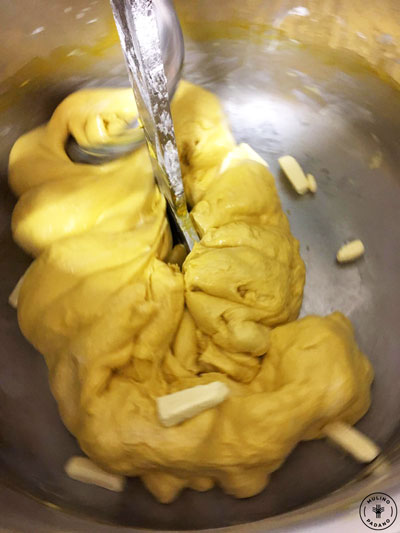
First beat the sugar into the water and then add the flour. Add the sourdough, which must be strong, and then, a little at a time, the egg yolks. At the end incorporate the butter, which can be slightly softened if necessary (figure 2). Between each insertion it is vital that the dough regains a good gluten mesh.
If you don’t have a sourdough starter but would like to make your own panettone, we suggest you read our article explaining how to make panettone starting with the creation of your own sourdough starter.
Once ready, the first mixture should be left to prove in a cling film covered container.
Within the arc of twelve hours the mixture should rise to one and a half times its original volume. In reference to the image below, the top of the dough should reach level 3.

The recipe for wheat germ panettone, the second mixture
In this phase the GranEssere fibres come into play!
For this recipe, as we want to make a wheatgerm panettone, we will be using
GranEssere Wheat Germ, but as you will already have realized, GranEssere fibres have numerous variations. Discover, for example, our recipe for wholemeal panettone.
Ingredients for the second mixture
- All of the first mixture (12.2 kg)
- 1.2 kg Type “00” Panettone flour
- 80 g Salt
- 1.2 kg Egg yolks
- 1.5 kg Sugar
- 400 g Seasoning, whose preparation will be explained later in the recipe
- 2 kg Butter
- 1 kg Water (whose dosage should be evaluated according to the absorbency and consistency of the dough)
- 310 g GranEssere Wheat Germ
Method for the second mixture
First of all it is fundamental to give the first mixture back its structure and strength by placing it in a mixer and adding all of the flour from the second mixture, together with the salt.
After this initial phase the dough should look like the following photo (Figure 4)

Now alternately add the egg yolks and sugar a little at a time. It is important that the dough always remains stringy. Next add the seasoning (prepared the day before by mixing together 400g of honey, 2 vanilla pods, the grated zest of 5 oranges and 2 lemons) and the slightly softened butter (Figure 5).

At this point add the water, taking care that the panettone dough remains stringy, until the desired consistency is reached. As far as how much water should be added, we recommend mixing in 200g at a time, even adding all of the water but never exceeding the maximum of 1 kg. To understand if the dough is properly hydrated its stringiness, shininess and extensibility should be evaluated. The image below shows the look the dough should have before adding the suspension.

Now is the moment to characterize the panettone with the GranEssere fibre of your choice. In this case, as already stated, we will use GranEssere Wheat Germ to make a wheat germ panettone.
All you need to do is add the GranEssere Wheat Germ to the mixer. In just a few minutes it will be homogeneously incorporated into the dough.
THE PERCENTAGES OF GRANESSERE FIBRES WE SUGGEST USING:
- GranEssere Coarse Bran: 11-13% of the total amount of flour used in the first and second mixtures.
- GranEssere Fine Bran: 12-14% of the total amount of flour used in the first and second mixtures.
- GranEssere Wheat Germ: 3-5% of the total amount of flour used in the first and second mixtures.
To create a fibre-rich panettone we suggest you use your own creativity when mixing in the GranEssere fibres, but without exceeding a total of 14% of the total amount of flour used in the first and second mixtures.
In this phase you could also add other suspensions, such as candied fruit or chocolate, balancing the quantity with the added fibre, but making sure that it does not exceed the total weight of the suspension.
The wheat germ panettone dough is now ready and should be left to prove for a further hour in one piece in a cling film covered container.
The dough should then be divided into pieces that weigh 10% more than the desired finished weight of the panettone after baking. For a 1 kg panettone the dough should weigh 1.1 kg.
Each piece should be formed into a compact sphere and left to prove for a further twenty minutes on the work top. Once this time is up it should once again be formed into a sphere taking care not to break the outer surface of the dough. These pieces are now ready to place into the paper baking moulds.
Leave the panettones to rise once again until they are one centimeter from the top if using a low mould, or two centimeters from the top if using a tall one.
We suggest that you pay particular attention to the proving phase as the presence of the wheat germ in the dough will lead to a shortening of the total proving time of a traditional panettone by about 1-2 hours.

Once the dough has risen cut a cross into the top of each panettone and place a knob of butter in the centre. Finally bake the panettones at 165 °C for roughly 50 minutes or until they reach a temperature of 94 °C in the centre. When baking smaller panettones reduce the baking time and slightly raise the temperature.
Once removed from the oven skewer the bottoms of the paper moulds so that they can be turned upside down whilst cooling.
Pack 12 hours after the end of baking.
You can follow this method using Type “00” Panettone flour that you can find in the section dedicated to the best flours for pâtisserie. In our on-line shop you can find Type “00” Panettone flour and GranEssere Wheat Germ in small sizes.