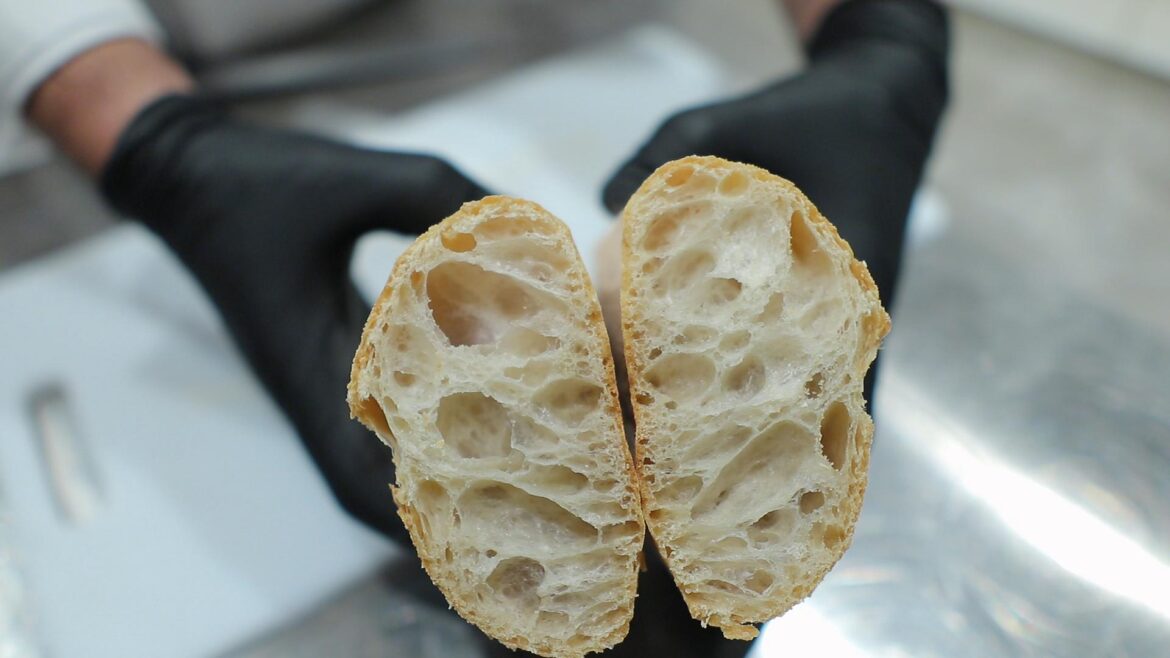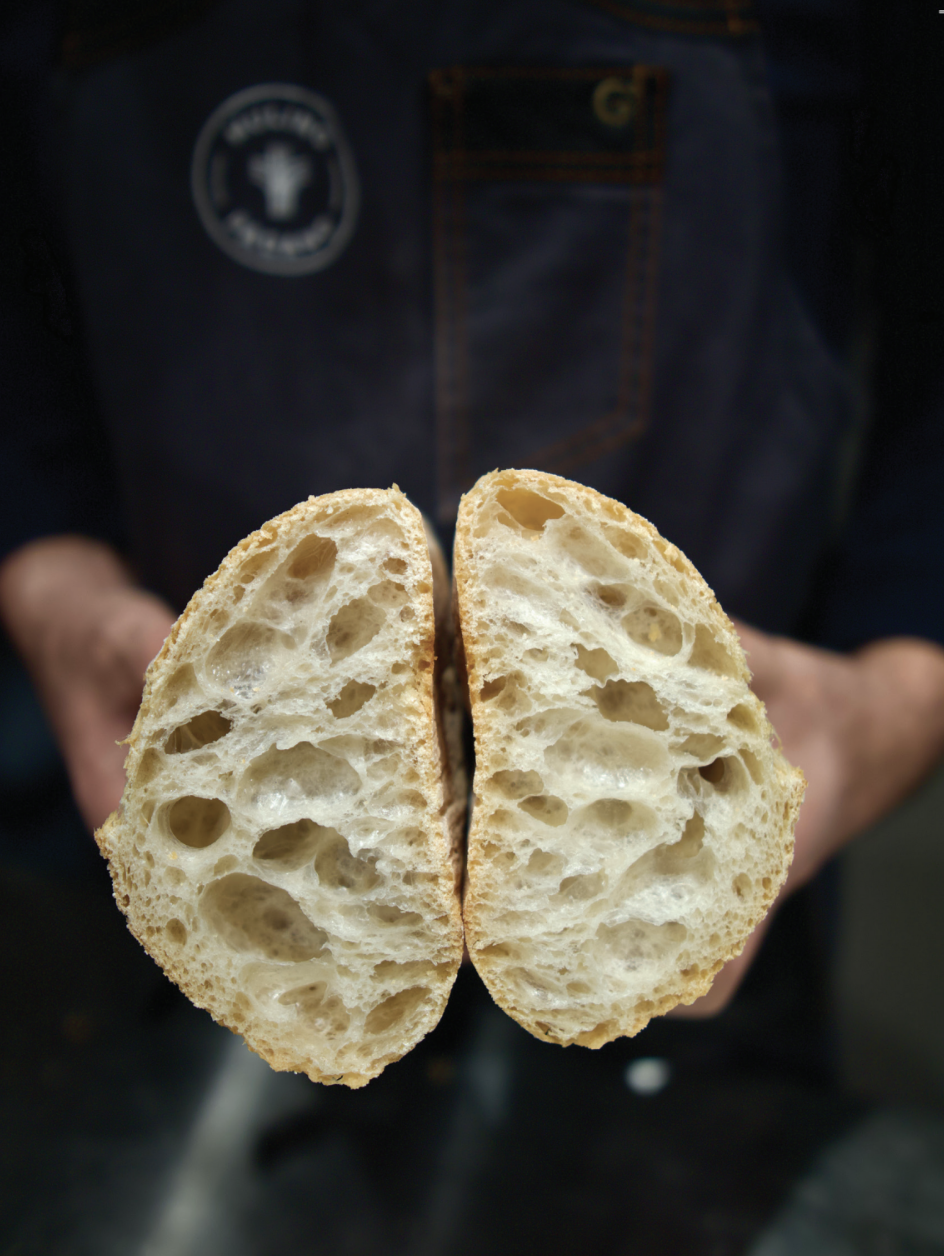
The history of Mulino Padano coincides with that of the Cavallari family, that has played a part in the cereal industry for over a century. The family’s long-lived passion led to the acquisition of their first mill in the mid-1930s. From that moment on, the Cavallari name has been closely linked to the milling industry and, in fact, in the following twenty years, the five brothers acquired a number of other mills in the Veneto and Emilia-Romagna regions of Italy. The history of the Ciabatta Polesana recipe begins here: discover it in this article!
The Ciabatta Bread recipe: a bit of history
It is September 21, 1982 and for Arnaldo Cavallari it feels like the right day. Since he had had the idea of creating a new type of bread, he had carried out hundreds of bread-making experiments. He had no doubts about the flour, in fact, like the true miller he was, he had paid attention to its every detail, from the choice of the grain to the regulation of his mill in Adria. Arnaldo was certain that with this flour, which he called Tre Esse, and a totally new working method, he could bake a bread like none ever seen before. On that day, after the completion of yet another test, he was convinced that he had reached his goal. Ciabatta bread was born!
Its diffusion was very rapid because, in addition to being tasty and versatile, it revolutionized the baker’s workload by eliminating the shaping phase of the dough whilst still obtaining a light, moist loaf. Thus, alongside the Baguette, Ciabatta became one of the most widely consumed loaves in the world and if today we all love moist, aerated bread, it is because on that day in 1982 Arnaldo had not “only” invented a new loaf, but much, much more.
The recipe is based exclusively on the use of biga and to make it we could propose nothing other than our type “0” Star flour, a direct descendant of the historic Tre Esse.
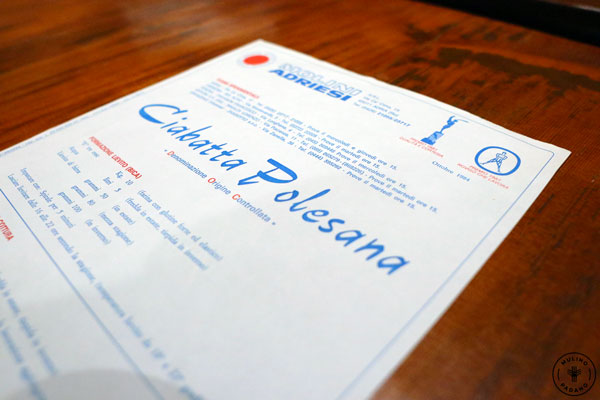
Ciabatta Polesana: recipe and method
Ingredients
For the biga starter:
- 1 kg type “0” Star flour
- 500 g Water
- 10 g Fresh brewer’s yeast
To refresh the starter:
- 200 g Water
- 22.5 g Salt
Method
Ciabatta Polesana is made using a biga starter, in which the biga is not refreshed with flour and brewer’s yeast (in another of our articles you can find the recipe for ciabatta based on biga using refreshment). For this bread to be successful, it is essential to make the biga starter without mistakes, paying close attention to the timing and the temperature.
Watch all the steps of the recipe in this video:
To properly prepare the biga starter, proceed as follows:
- Place the flour, brewer’s yeast and the water for the biga, which must be at room temperature, into the mixer.
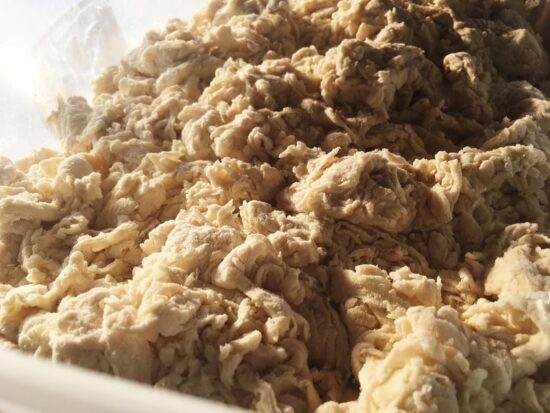
- Mix for 3-4 minutes at first speed and, if the mixer allows, in reverse. If you do not have a mixer, you can also make the biga by hand in a bowl. Regardless of the method you intend to use, the biga is ready once all the flour has been mixed in and there are no powdery residues. It should be emphasized that you must not create a dough, otherwise the biga will not mature correctly.
- To finish the biga, leave it to rest covered with a cling film for 18/24 hours in a cold storage room at 18/19 °C with 70% relative humidity. If you do not have this opportunity, place it somewhere at this temperature.
The following day we move on to the second phase of the recipe, the so-called “refreshing” of the biga starter:
- Place the biga starter into a mixer, taking care to break it up into small pieces to facilitate kneading. At this stage you can also add another ingredient present in the original recipe, diastatic malt (1% of the weight of the flour), which helps to facilitate the subsequent proofing process and allows you to obtain a golden-brown product characterized by a thin and crunchy crust. If you do not have this ingredient, simply eliminate it from the recipe but do not replace it with sugar or honey; this is a common practice, but totally incorrect, as we explain in our article about “Falling Number”.
- Mix, gradually adding the water for refreshing, which must have a very precise temperature, worked out using from the following formula:
55 (fixed n°) – room temperature – flour temperature = water temperature - After kneading for about 7 minutes at first speed, approximately ⅔ of the water should have been added. At this point, add the salt and switch the mixer to second speed for another 10 minutes or so, until you obtain a smooth dough characterized by a perfect gluten mesh. It should be remembered that the final temperature of the dough should remain around 26 °C.
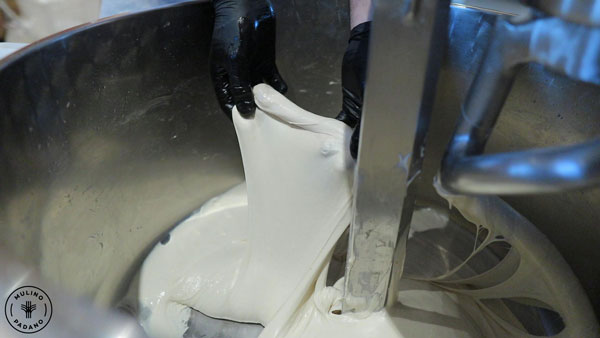
The Ciabatta Polesana dough thus obtained is very hydrated and therefore requires some skill to handle in the correct way. Let’s see how to proceed with the proofing, shaping and finally baking:
- Remove the dough from the mixer and leave to rest in a container covered with cling film for 45-60 minutes.
- When this time is up, turn the dough out onto a well-floured work surface and flour the top of the dough as well. This dusting will allow you to cut it correctly.
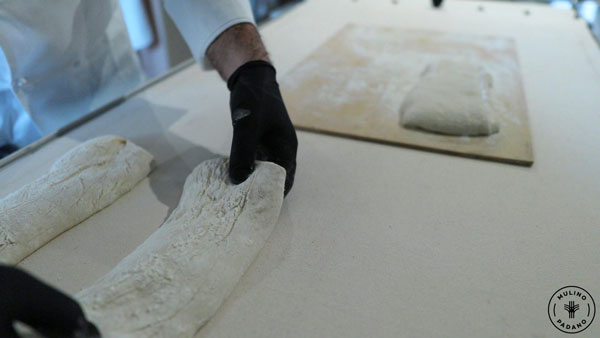
- Cut the dough into rectangular pieces of 300-500 g and place each loaf on a well-floured board. Leave to rise, at room temperature, for 45-60 minutes.
- Place the loaves on a baking sheet (or, at home, a baking tray). Turn them over and stretch them gently, then bake them, with steam, for approximately 25-30 minutes at 230-240 °C.
- Open the dampers 5 minutes before the end of baking. In your home oven, bake for a few minutes less and leave the Ciabatta in the oven with the door open for a few minutes longer.