When you think of Christmas and its laden table, what dessert springs to mind?
Many desserts were created to celebrate special occasions, important events or, as in the case of Christmas, religious holidays. Often these desserts do not travel far and we in Italy know only too well how many recipes continue to live on only in limited areas, sometimes even jealously guarded by a handful of families.
Christmas has always given us ideas for the creation of new delicacies and the whole world has fallen in love with two of them: Panettone and Pandoro. Despite this fact, it would be too easy to reply to the initial question by naming just these two well-known cakes. So, driven by the desire to discover more about the desserts that contribute to making Christmas special in so many countries, we have decided to make a collection of Christmas Desserts. To create this, we involved our community and each recipe, in addition to having a brief description, is accompanied by the name of the person who supplied it and its country of origin. Furthermore, we would like this collection of Christmas delicacies to expand over time, so at the bottom of this article you will find a link to a form that you can fill out to add your own your valuable contribution.
The magic of Christmas is special because it has countless forms, meanings… and delicious desserts. Let’s make the most of it!
The Collection
Aachener Printen (Aachen, Germany). A variation on gingerbread.
Martin Henne
Anello di Monaco (Mantova, Italy). A highly leavened cake filled with a crème made with hazelnuts or, sometimes, chestnuts.
Ketty Grandi
Bisciola (Valtellina, Italy). A lower kind of panettone which mixes soft wheat flour with rye or buckwheat, and contains dried figs, raisins and walnuts.
Roberta Della Patrona

Bolo Rei (Portugal). A crown-shaped cake whose name alludes to the three wise men. Round in shape, with a large hole in the centre, it is made of a soft white dough enriched with eggs and often liqueurs or wines mixed with raisins, nuts and candied fruit. In the past the cake hid a dried broad bean and a small toy, usually made of metal. Whoever found the broad bean in their slice would have to pay for the next kings’ cake, on the other hand, whoever found the toy would receive good luck.
Maria Sorba
Bossolà (Brescia, Italy). The dough is very similar to that of a pandoro, but its shape is that of a large ring-doughnut that is not completely hollow in the center.
Nicola Zanella
Buccellato (Palermo, Italy). A Sicilian short-crust pastry case filled with figs, nuts and orange marmalade, decorated with lace made with special implements.
Ileana Arceri
Bûche de Noël (Paris, France). A traditional sponge cake made to resemble a miniature Yule log.
Luigi-Alberto Sanchi
Cartellate pugliesi (Bari, Italy). A dessert typical of Apulia made with cooked grape or fig wine. Mix flour, oil and white wine to make a dough. Shape it into long, narrow strips and pinch them to form the famous roses. Leave them to dry to avoid opening during cooking and then deep fry in plenty of oil. In a pan heat the cooked wine with a little red wine and dip the Cartellate into the mixture. You can use honey instead of cooked wine, but the flavour is completely different.
Tina Ottanta
Cassata siciliana (Palermo, Italy): A sponge cake with a sheep’s ricotta crème, covered with pistachio marzipan, lacquered with dark sugar and decorated with lots of candied fruit.
Ileana Arceri
Castagnaccio (Venice, Italy). A cake made with chestnut flour and cocoa.
Fabrizio Zuliani
Christstollen (Germany). A rich, compact loaf made with dried fruit, candied peel, almonds and sometimes marzipan, all covered in icing sugar.
Naomi Schmidt
Cozonac (Moldova). A braided loaf made with butter, eggs, milk and sourdough filled with hazelnut crème patisserie and lots of poppy seeds and dried grapes.
Olga Trifautan
Frustingo (Fermo and Ascoli Piceno, Italy). A Christmas cake typical of the Marche region made with dried fruit and figs. The original dough calls for the use of stale bread softened in dried fig broth and mixed with sapa (cooked wine must).
Simone Moriconi

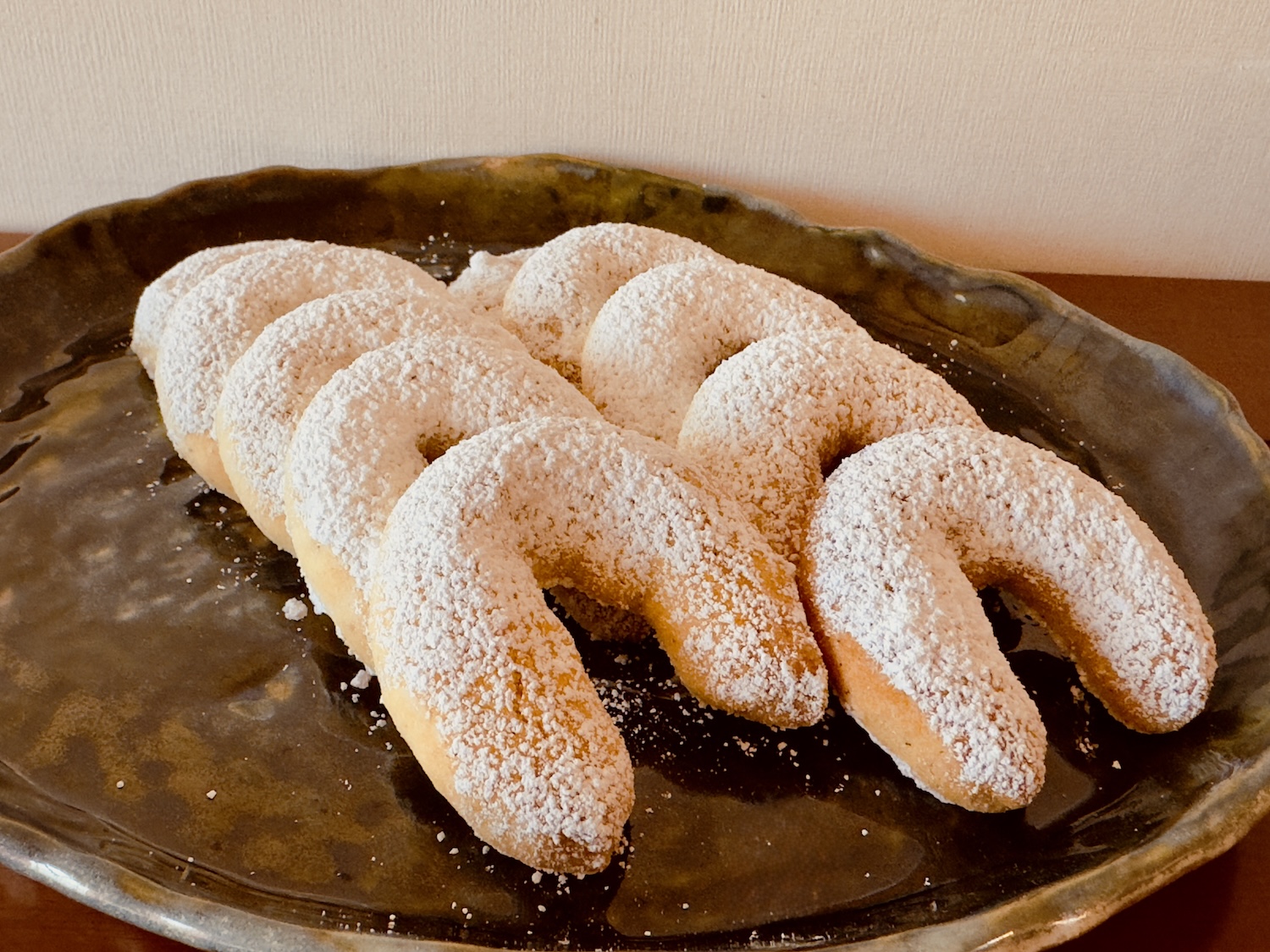
Kipferl (Austria and Hungary): Kipferl are traditional Christmas biscuits of Austro-Hungarian origin. They are made with butter, icing sugar, ground almonds, patisserie flour, and vanilla. They are characterised by a distinctive crescent shape.
Emanuele Cozzi
Kozuli (Russia): Kozuli are traditional Christmas biscuits that originate in the northern regions of Russia. Made with a sweet, spiced, honey-based dough, they are shaped into figurative shapes—animals, houses, angels—and decorated with fine white icing. They represent one of the most artistic expressions of Russian Christmas baking, a symbol of celebration, family, and ancient customs.
Ekaterina Zhelobkova
Lonzino di fico (Ancona, Italy). Once a winter-spring dessert, today it is consumed only as a Christmas holiday dessert. It is made with a mixture of chopped dried figs flavoured with liqueur, to which nuts, especially almonds and walnuts, are added. It is tied up with a string and served cut into thin, but not too thin, slices, just like “Lonzino”, a cured pork loin.
Laura Torbidoni

Mantecados (Spain). A crumbly biscuit to be eaten with coffee for Christmas breakfast or after dessert. Mix the weak cake flour with icing sugar, pork fat and cinnamon. Some recipes include almond flour and some varieties require the use of lemon zest or cocoa. After mixing the ingredients together in the right proportion, the biscuits are shaped and baked.
Maria Cantos Soto
Miacetto (Cattolica, Italy). Miacetto (mnacét or miacét in Cattolica’s Romagnolo dialect) is a typical Christmas cake from the city of Cattolica in the province of Rimini made with dried fruit, sugar, bran (or flour) and honey, but without any yeast. This name derives from the Latin milaceus (millet), from which the terms migliaccio and miaccio come, which in different regions of Italy indicate completely different sweet or savoury focaccias, united only by being yeast-free. It is unknown in the other territories of Romagna. There is only one traditional recipe that has some similarities: bustreng from Borghi, Montefeltro and the upper Savio Valley. It is prepared at home (with various families passing down of the recipe from generation to generation with their own small variations) during the Christmas period, when it is also put on sale in pastry shops and bakeries. In Cattolica, now as in the past, preparing miacetti and giving them as gifts, is a way of strengthening bonds with relatives and friends.
Marco Livi

Mince Pie (England). Individual shortcrust pastry pies filled with dried fruit and pork suet, served hot.
Paul Mochrie
Nacatole (Siderno, Italy). Fried pastries whose name comes from Naca, which means cradle, in fact their shape resembles the cradle of the baby Jesus. They are made with flour, eggs, brewer’s yeast, extra virgin olive oil, milk, sugar and grated lemon or mandarin zest to taste. There are also slight “family” variations.
Francesco Lizzi
Pabassine sarde (Sardinia, Italy). A biscuit rich in nuts and raisins, with a slight hint of orange. Its particularity is the crumbliness given by the lard.
Francesca Sanna
Pampepato di Ferrara (Ferrara, Italy). A round-shaped pastry, characterized by a dough made of soft wheat flour, cocoa, nuts and candied fruit. It is iced with chocolate.
Paolo Brunelli
Pan dolce basso (Genoa, Italy): A low, crumbly panettone rich in pine nuts and candied fruit.
Giulio Ben
Pandolce genovese alto “Pandöçe” (Genoa, Italy). Eaten in Genoa especially at Christmas, but appreciated all year round, Pandüçe is a not very sweet bread with lots of raisins, candied orange and citron peel and pine nuts to which a little butter, orange blossom water and fennel seeds are added. The original pandolce is the tall leavened bread, made with sourdough. It has a circular, domed shape, with a triangular cut on the top. Only after the invention of chemical yeast, a lower version with more butter, which is easier to make, was also proposed. It is proofed twice to obtain a soft and long-lasting product.
Maura Sasso
Pane di Natale (Modena, Italy). A Christmas bread made with flour, butter, sugar, eggs, chocolate, dried figs, sultanas, almonds and peanuts, all mixed together with Savor, a special jam typical of the Emilia-Romagna region of Italy. Once baked, the bread is moistened with a generous quantity of Saba, a concentrated grape syrup.
Laura Buffagni
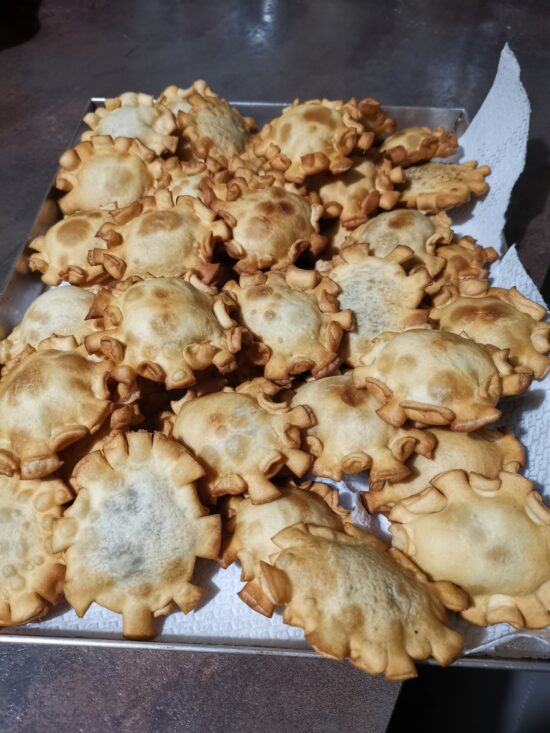
Pasticelle di Castagne (Cilento, Italy). Ravioli filled with chestnuts, dark chocolate, sugar, coffee, mandarin zest, Strega liqueur, sultanas and pine nuts which are fried and then covered with honey or icing sugar.
Annamaria Napoli
Porcospino (Emilia-Romagna, Italy). A dessert in the peculiar form of a hedgehog but not difficult to prepare. Savoiardi soaked in coffee and liqueur, covered with butter cream. Almonds form the spines of the hedgehog while the coffee beans form the eyes and nose.
Silvia Bortolini
Red velvet cake (USA). Created in the southern states of the United States of America in association with Christmas, it is now eaten all year round. It is a cake with alternate layers of sponge, dyed with red food colouring, and cream cheese frosting that also covers the outside of it. You can add chopped walnuts or hazelnuts, berries, grated coconut or sugar glitter as decoration to the cake.
Alessandro Fabbri
Sonhos (Portugal). Their name means “dreams” and they are fritters. There are different versions, such as: “Sonhos de Requeijão” (cottage cheese dreams) and “Sonhos de abóbora” (pumpkin dreams).
Ana Gonçalves

Struffoli napoletani (Naples, Italy). Small balls of fried dough, topped with honey, candied fruit and colored sugar.
Corrado Irlando
Tourte Auvergnate (France). This is a classic rye bread that is made all year round but is a big hit around Christmas time. In Tourte Auvergnate you often find dried figs, apricots or raisins, or a combination of the three, but in Agen, a city known worldwide for its plums, these are usually added to the dough. A perfect combination of the acidity and sweetness of the fruit. The process of kneading the bread is also quite special, as it is 100% rye and contains no gluten, so you actually gelatinize the starch using boiling water.
Vincent Fogaroli

Zelten (Trentino, Italy): A sweet made with dried figs, almonds, walnuts and hazelnuts, dates, butter, sugar and candied fruit; a delicacy made of simple but precious ingredients.
Alberto Cogo
… A Collection that gives you an idea of what a kaleidoscope of delicious sweets Christmas can inspire!
And now, to improve it, we ask for your help too…
Click here to complete the form and tell us about a sweet typical to your area, or any other part of the world where you are familiar with the Christmas dessert. We will then publish it in this Collection. Thank you!