How to choose flour for your pizza: The complete guide to the best pizza flour
In-depth19 March 2025

Italy is the home of pizza, but to tell the truth there are so many types: Neapolitan, Pizza alla Pala, Contemporary, Romana, Tray-bake, but also Fried Pizza, Focaccia and so on…
The variations of the most famous Italian dish in the world are many and varied and, if you want to interpret them and prepare them at their best, it is necessary to choose the right ingredients. In this article we will try to answer one of the questions we are asked most frequently: which flour should I choose for my pizza? A question that is posed by both master pizza chefs and home-bakers alike, two “worlds” that share their love of quality pizza and a strong desire to deepen their knowledge of the ingredients.
In this article we will start by looking at the theory behind choosing the best flour for your pizza, which depends on which recipe you intend to make, and understanding how the other ingredients in the dough interact with the flour. This information, combined with the knowledge of the specific needs of both home-bakers and master pizza chefs, will allow us, in the second part of the article, to identify the best flour for homemade pizza and the best flour for professional pizza.

How to make pizza dough: the importance of choosing the ingredients
To make a good pizza, a perfect understanding of how the various ingredients in the dough interact with each other is essential. But first, let’s start by learning how to choose the right soft wheat flour for the type of pizza you intend to prepare.
Choosing the best flour for your pizza
Let’s consider a ball of dough for a 250 g Neapolitan pizza, made with 65% hydration and 2.5% salt. The main ingredient is soft wheat flour which makes up approximately 60% of the ball.
Soft wheat flour is an ingredient that should not be taken for granted and should be understood from a technical point of view to avoid the risk of using it incorrectly.
We have dedicated many in-depth articles to the rheological values of flour, that is to say, the set of data that can explain how a flour behaves during processing, from kneading to baking. To know how to choose the right flour, it is therefore essential to know the meaning of values such as W and P/L, the absorption of the flour, the extensibility of the flour, the Falling Number and the granulometry. In this article we will use all this technical information to respond quickly and easily to those who wonder what the best type of flour, for the type of pizza they intend to make, is.
Many of these values depend directly on the quality and quantity of the protein content of the flour, which in turn depends directly on the type of wheat milled. Obviously, the milling technique is of capital importance in enhancing the original characteristics of the wheat. An excellent wheat if milled or cleaned incorrectly will never make a good flour!
It could be said that the values listed above are those that best describe a flour, but there is another piece of information that precedes these. The ash content, is the data that allows us to differentiate between flours based on their type, as shown in the table below.
| Flour |
Minimum Ash | Maximum Ash |
|---|---|---|
| Type “00” | – | 0.55% |
| Type “0” | – | 0.65% |
| Type “1” | – | 0.80% |
| Type “2” | – | 0.95% |
| Whole Wheat | 1.30% | 1.70% |
So, what kind of flour do pizza chefs use to make pizza?
There is no one single answer to this question as the flour to be used varies with the type of pizza dough to be made. To simplify matters, it could be said that there are two main variables on which a dough is based: its maturation and proofing times and its hydration.
The proofing and maturation times can be used as a guide in choosing the strength of the flour, known as W. As we will see later in this article, as the proofing time increases, flours with a higher W are preferable.
Likewise, as the percentage of hydration in the dough increases, the strength of the flour must also increase.
For example, for a classic pizza, made with 65% hydration and an 8-hour proofing time, a strong flour with a W higher than 320 should not be used because its characteristics would not have time to develop and the pizza’s consistency would be incorrect.
If, on the other hand, a dough characterized by a longer proofing time and/or greater hydration were to be made, it would be necessary to increase the strength of the flour (which is directly connected to its protein content) in order to be able to count on a gluten mesh with a better performance.
The gluten mesh has always made type “0” and “00” flours preferable for pizza dough. In fact, a flour with fewer bran parts finds fewer obstacles in the formation of a correct gluten mesh, and also helps when rolling out the dough. However, as we will see later in this article, the evolution of doughs has allowed more and more pizza chefs to move towards other types of soft wheat flours, with very interesting organoleptic and nutritional profiles.
Fig. 2 The creation of the gluten mesh during the kneading of a pizza dough.
The balanced protein content, the W and the type of flour are certainly essential elements in the identification of the correct pizza flour, but the other rheological values are also important and for in-depth analysis of them we refer you to the guide dedicated to how to choose the right flour based on rheological characteristics. To give some examples, a flour with a correct W but characterized by a very high P/L or by low stability or, indeed, in a reduced ratio or by insufficient absorption, will not lead to a well-made pizza.
To evaluate, therefore, whether a certain pizza flour is correct for the recipe you intend to make, our suggestion is to carefully read the technical sheet, checking the flour type, the percentage of proteins and the W. If these data are aligned with those expected, check that the other rheological values are also consistent.
Later in the article we will indicate the rheological values for each type of pizza.

Balanced protein content, W value, and flour type are undoubtedly essential elements in selecting the right pizza flour, but other rheological values are also important. For a more in-depth discussion, refer to our dedicated guide on how to choose the right flour based on its rheological characteristics. For example, a flour with the correct W value but characterized by a very high P/L ratio, low stability, a reduced ratio, or insufficient absorption will not result in a well-made pizza.
To assess whether a pizza flour is suitable for the intended recipe, we recommend carefully reading the technical sheet, verifying its type, protein percentage, and W value. If these values meet expectations, ensure that the other rheological parameters are also consistent.
Later in the article, we will outline the rheological values for each type of pizza.

The correct use of the other ingredients in pizza dough
The choice of the best pizza flour could obviously be ruined by the improper use of other ingredients, so it is good to follow some essential guidelines.
After the flour, the ingredient that makes up most of the pizza dough is water. Its quantity varies greatly: from 60% (i.e. 600 g of water per 1 kg of flour) for a classic round pizza up to 85% for a pizza alla pala or tray-bake pizza. In any case, the addition of the water to the mixture must be gradual, to allow the gluten mesh to form correctly.
For direct doughs with very elevated hydration, like recipes that require the use of wholemeal flour or a significant presence of fibre, the autolysis technique is suggested. This consists of pouring all the flour and an initial quantity of water corresponding to 65% hydration into the mixer and after 4 minutes of kneading, covering the mixture with plastic film. At this point autolysis begins. After no less than at least 20 minutes, resume kneading, adding first the yeast and then, with the correct timing, all the other ingredients.
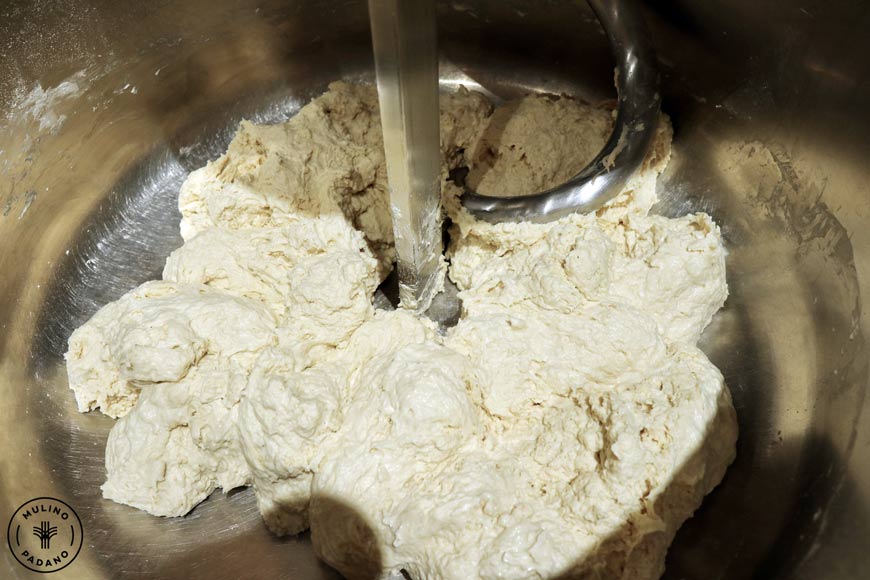
Continuing with the presentation of the other ingredients in the pizza dough, we find salt. It is usually present in a quantity that can vary between 1.5% and 3% of the weight of the flour.
In a similar percentage, but only in certain pizzas such as pizza alla pala, tray-bake pizza and focaccia, we also find EVO oil (Extra Virgin Olive Oil).
The final ingredient in the dough is yeast. In truth, its percentage varies greatly depending on the type of yeast: from 20% – 30% of the weight of the flour if it is a sourdough starter, to 0.05% – 0.5% in the case of fresh brewer’s yeast. Although we would not recommend it, you can also use dried brewer’s yeast, which should be used in a ratio of 1 to 3 compared to fresh brewer’s yeast (1 g of dried corresponds approximately to 3 g of fresh).
These guidelines are very simple, but they are the basis of a successful pizza recipe. They should therefore be taken into consideration if you want to create tasty, aesthetically pleasing and, toppings permitting, light and digestible pizzas
The best flour for professional pizza
Regardless of what kind of pizza you intend to make, as every pizza chef very well knows, the flour must have a further quality from those mentioned at the beginning of the article. It is just not about the W, nor the P/L or the absorption, but above all about consistent quality. Dough after dough, service after service, the quality of the pizza must remain unchanged and it is vital to be able to count on stable, constantly high quality flour.
Having said this, we can look at some of the main types of pizza and associate them with the most suitable pizza flour.
Flour for Neapolitan Pizza
Neapolitan pizza is certainly one of the best loved and to make it we recommend a type “00” or type “0” flour, with a protein value of 12-13%, W 260-320 and a P/L around 0.60. These characteristics are well represented by our type “00” S10 flour.
Flour for Contemporary Pizza
One version of pizza that is becoming increasingly popular is the so-called “contemporary pizza”, which is characterized by a higher hydration and more developed crust than the Neapolitan. This type of pizza is usually based on a starter, which is often biga. For this reason it is important to use a stronger flour (W of 330 – 360) with good stability (at least 16 minutes) and absorption. These characteristics are found in our type “00” S15 flour.

Flour for Pizza alla Pala
As for contemporary pizza, so for the recipe for Pizza alla Pala is often based on a starter, a prolonged proofing time (24-48 hours) and significant overall hydration. As we will see later in this article, it is also interesting to make these products with flours other than type “0” and “00”, but if you want to remain faithful to these, we confirm the choice of our type “00” S15 flour. Its balanced protein, never less than 13.5%, will be a trusty ally both in the dough and whilst proofing.

Flour for long-proofing pizza and high-hydration pizza
For doughs with even longer proofing or with hydration levels higher than 80%, we suggest a flour with the highest protein value (15%) and great absorption and stability (more than 18 minutes). In our range this product is called S20 (link a store) which is the perfect choice for those who need very high performance flour.
Flour for focaccia and soft tray-bake pizza
The Recipes for focaccia and soft pan pizza are usually characterized by short or medium proofing times and by less hydrated doughs. The end result should be soft and be light on the palate. For this reason it is good to use a flour with a protein content of around 12%, good extensibility (P/L less than 0.65) and W between 290 and 320. Our proposal, remaining within the scope of type “0” and “00” flours, is our type “00” S10 flour.

The best flours for pizza: alternatives to types “0” and “00”
As we said at the beginning of this article, the world of pizza has greatly evolved, opening up to types of soft wheat flours that can provide very interesting organoleptic and nutritional values. Type 1, type 2 stone-ground and wholemeal doughs can now be made thanks to the precise milling techniques that are now employed to make the corresponding flours. In our case, much effort is dedicated to the development of wholemeal and other fibre-rich flours. To explain this further we have dedicated an in-depth article to what bran is.
A pizzeria also means experimentation. So we recommend trying the ingredients and flours from our GranEssere range, such as Wheat Germ or GustoFibra N°4 flour, unique products, which allow you to personalise your dough to the maximum, making it unique. Try for example fibre-rich Pizza alla Romana or tray-bake pizza with wheat germ.
And not only experimentation, but also the rediscovery of the territory. if you want to have an even closer relationship with the story of the raw materials, then we recommend the Granaio Italiano range which offers flours from a supply chain certified according to the UNI EN ISO 22005:2008 standard.
As we have shown, the Mulino Padano range of pizza flours is ample and some of them can be found to buy online both in 1 kg and 5 kg packs, perfect for home-bakers and enthusiasts alike. In fact, thanks to high performance, small-sized mixers and ovens equipped with refractory stones, you can create very high quality pizzas in your own home. To do this it is obviously essential to be able to count on top-quality ingredients. Therefore, in our Shop you can find all the quality that we reserve for the professionals, in a small quantities and are thus able to choose the best flour for homemade pizza.

In Conclusion
- The main ingredient in pizza dough is flour and it is therefore important to understand it well from a technical point of view;
- the choice of the best pizza flour depends on the desired characteristics of that the dough you intend to make and, as we have seen, the two most important variables are the level of hydration and the proofing and maturation times;
- the rheological values tell us whether the flour used in a certain pizza recipe is right or not;
- the choice of the best pizza flour could obviously be ruined by the improper use of other ingredients, so it is a good idea to follow some essential guidelines;
- the world of the pizzeria has evolved a lot, opening up to types of soft wheat flours that can provide very interesting organoleptic and nutritional values. Type 1, type 2 and wholemeal flours can now be used to make pizza dough thanks to the precise milling techniques used to create them.